
Mobile gaming has outpaced both console and PC gaming in terms of global revenue and player base. With titles like Genshin Impact, Call of Duty: Warzone Mobile, and Free Fire MAX pushing the boundaries of mobile hardware, the operating system (OS) running beneath these games matters more than ever.
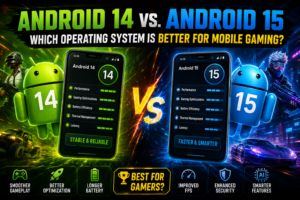
As Android 15 achieves widespread adoption across flagship and mid-range devices in 2026, many gamers are wondering: Is it worth the upgrade, or should I stick with the tried-and-true Android 14?
In this technical breakdown, we analyze how both operating systems handle resource management, thermal throttling, and background processing to determine which OS reigns supreme for mobile gamers.
1. The Baseline: Android 14’s Gaming Legacy
Android 14 was a pivotal release for mobile performance. It introduced several under-the-hood optimizations that specifically benefited heavy applications:
- Frozen Cached Apps: Android 14 drastically improved how it handles apps running in the background. By aggressively “freezing” cached apps, it prevents background processes from eating up CPU cycles, leaving more raw power available for the active game.
- Predictive Back Gesture: While mostly a UI improvement, the smoother rendering of system-level animations in Android 14 meant fewer frame drops when transitioning between a game and the home screen.
For most gamers, Android 14 remains incredibly stable. If you are playing well-optimized, older titles (like Subway Surfers or Temple Run 2), you likely won’t notice a massive difference by upgrading.
2. Enter Android 15: The Performance Powerhouse
Google engineered Android 15 with intensive, sustained workloads in mind. For hardcore gamers playing demanding 3D titles, Android 15 introduces several game-changing APIs (Application Programming Interfaces).
The Dynamic Performance Framework (ADPF) Upgrades
The biggest advantage Android 15 holds is its upgraded Android Dynamic Performance Framework. This system allows the game to communicate directly with the phone’s thermal and power management systems.
- Power Efficiency Mode: In Android 15, games can now specifically request a “power efficiency mode” for background threads. This means the game can tell the OS to use the less-powerful, battery-saving CPU cores for simple tasks (like rendering the UI or playing background music), saving the high-performance CPU cores exclusively for heavy physics calculations and 3D rendering.
- Sustained Performance: Have you ever noticed your game running at 60 FPS for ten minutes, only to drop to a choppy 30 FPS because your phone got hot? Android 15 gives developers much better thermal headroom hints. The OS can intelligently throttle background system tasks before it throttles the game itself, resulting in much smoother, sustained framerates during long gaming sessions.
3. Storage and Load Times
Nobody likes staring at loading screens. Android 15 introduces subtle enhancements to file system handling. While hardware (having fast UFS 4.0 storage) matters most, Android 15’s refined memory management allows large game assets (like high-resolution textures in BGMI or Shadow Fight 3) to be loaded from storage into RAM slightly faster and more efficiently than Android 14.
4. Background Distractions and Immersion
Gaming requires focus. Both operating systems feature a “Game Mode” or “Do Not Disturb” function, but Android 15 handles system interruptions better.
Android 15 introduces stricter rules regarding when background apps can force a foreground service. This means you are significantly less likely to experience a micro-stutter in your game because a random shopping app decided to update its location data in the background.
The Verdict: Should You Upgrade?
If you are a casual gamer playing lightweight arcade games, Android 14 is perfectly adequate. It is highly stable, and you do not need to rush out and buy a new phone just for an OS update.
However, if you are a competitive player or you regularly play graphically intense, massive multiplayer games, Android 15 is the clear winner. The enhancements to the Dynamic Performance Framework alone—allowing games to run cooler and maintain high framerates for longer periods—make it a crucial upgrade for the modern mobile gamer.
Have you upgraded to Android 15 yet? Have you noticed a difference in your gaming performance? Let us know your thoughts in the comments below!

ID recovery